Organize realized gains, dividends, account placement, and trade timing so you can keep more of what your portfolio earns.
Claire Bennett
Read U.S. stocks with an AI-assisted, discipline-first framework.
I’m Claire Bennett, and I help you study the market, compare quality businesses, manage tax drag, and build a cleaner equity plan for your own goals.
What I cover Stock selection, portfolio construction, tax-aware trading, and downside control.
How AI helps AI helps organize the data so you keep the final judgment in your own hands.
Who it is for New investors and experienced investors refining an existing stock plan.
About Claire Bennett
A stock-investing advisor focused on discipline, quality, and long-term compounding.
I’ve spent 14 years helping U.S. investors think more clearly about stocks and equity portfolios. I started in boutique asset management, then built an AI-assisted investing process designed for ordinary investors who want institutional-grade thinking without the noise. My work centers on stock research, portfolio construction, tax-aware trading, retirement-account equity strategy, and risk control.
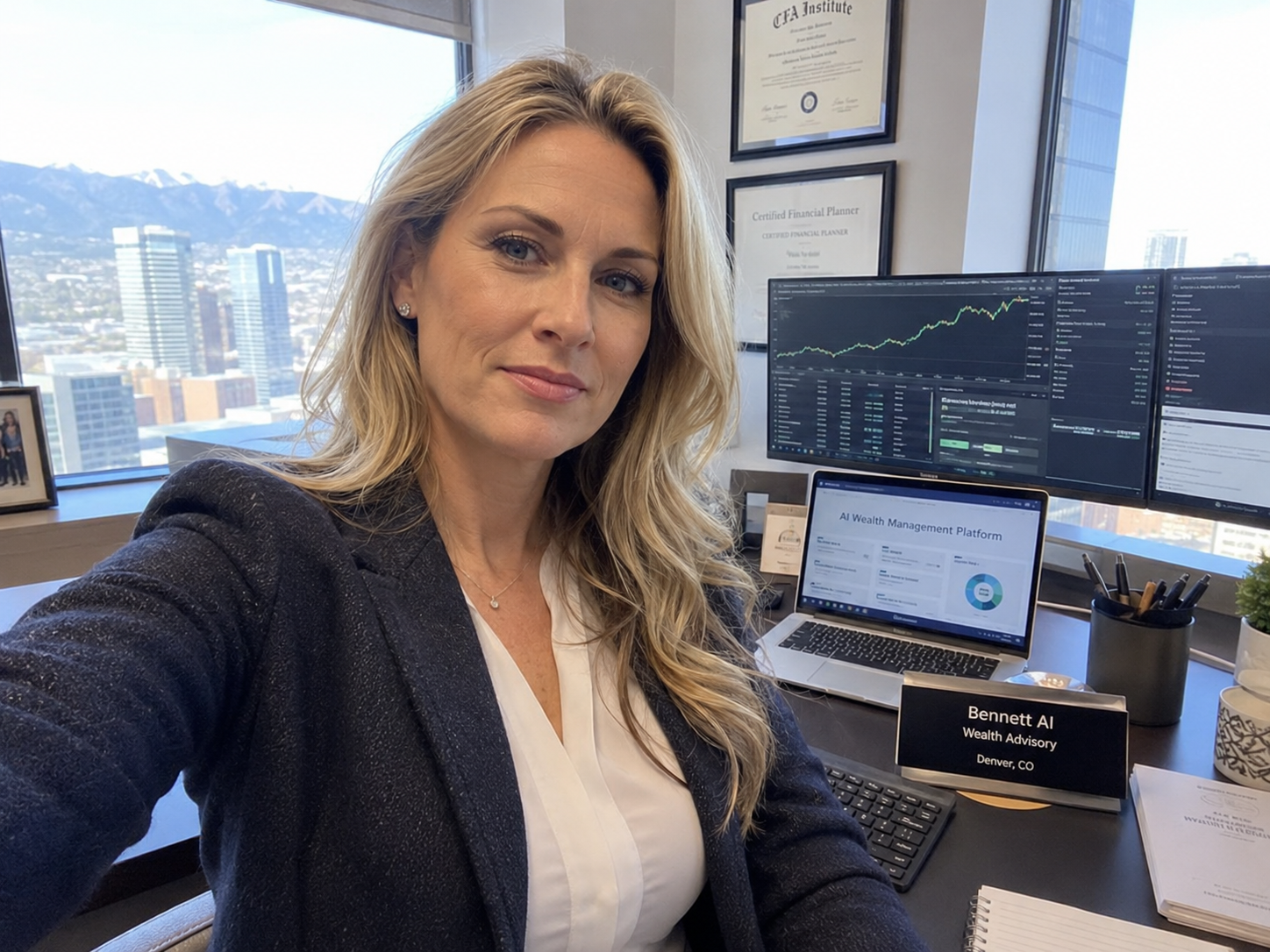
Claire Bennett
Denver-based CFP®, CFA, SEC RIA
I help you turn scattered stock questions into one cleaner investing plan. If you are just getting started, I keep the first stock framework simple enough to follow. If you already have a portfolio, I help you test whether it still works after taxes, market swings, sector rotation, and valuation changes.
My focus is always the same: make the next stock decision clearer, not louder.
Education
CU Boulder + DU Daniels
Finance degrees from two Colorado business schools.
Credentials
CFP® · CFA · SEC RIA
Planner, analyst, and registered investment adviser.
Experience
14 years
U.S. stock investing and equity portfolio management across market cycles.
Practice
Fee-only
Client-aligned, non-commission stock advisory work.
Who Claire helps
The investors who usually ask for help first.
If you are trying to read the market, build a stock portfolio, and keep tax drag under control at the same time, this is the kind of framework Claire builds first.
Map out stock selection, position sizing, sector exposure, and cash management for a steadier equity path.
Plan how taxable, retirement, and education accounts should hold equities before you lock in the structure.
Decide how cash, bonds, equities, and hedges should work together across your total investment picture.
Review concentration risk, drawdown risk, and downside gaps so one bad stretch does not break your plan.
Use AI to organize the data, test scenarios, and keep the process disciplined without turning judgment over to a machine.
Three market reads
Three articles to read first if you want the market to make more sense.
These are the notes I would put at the top of the stack when you want a faster read on AI, index breadth, and quality.
AI leadership
AI leadership is still the market's loudest signal.
If you want to understand why NVDA, MSFT, AVGO, and AMD keep coming back to the center of the tape, start with the gap between demand and expectations.
The real question is not whether AI is real. It is whether growth, margins, and valuation can still move together after the market has already paid for so much optimism. That is why leadership can stay intact and still become more fragile at the same time.
- Watch whether demand still justifies the premium.
- Watch whether margins stay strong enough to support the trade.
- Watch whether the same names are carrying too much of the move.
Market breadth
QQQ and SPY tell you whether the rally is broad or narrow.
A rally can look powerful even when only a few names are doing the heavy lifting. That is why you should always ask whether the move is broad enough to last.
When QQQ leads and SPY only partly confirms, the market is often leaning on a narrow group of winners. That can work for a while, but it usually leaves the tape more fragile than it looks from the outside.
- Check whether participation is widening underneath the headline move.
- Check whether the strongest names are being confirmed by the broader tape.
- Check whether the rally still looks durable if leadership rotates.
Quality read
Megacaps keep showing up because quality still matters.
AAPL, AMZN, GOOGL, and META stay relevant when the market wants durability, cash flow, and ecosystem strength. But premium names still have to earn the premium.
If the business stays strong but the valuation gets stretched, the market can still reprice the stock quickly. That is why quality is only half the story; the other half is whether the price leaves enough room for the next chapter.
- Watch whether cash flow still supports the premium.
- Watch whether execution keeps up with expectations.
- Watch whether quality is still priced reasonably.
Official career record
The career track that shaped Claire's investing process.
If you want the background that explains how this style of stock work was built, start with the record below.
| Time | Firm | Role | Key achievements |
|---|---|---|---|
| 2012 - 2017 |
Colorado Capital Management
Senior Stock Investment Advisor
|
Advanced stock investment advisor |
|
| 2017 - 2021 |
Denver Wealth Partners
AI U.S. Stock Strategy Director · Partner
|
AI U.S. stock strategy director |
|
| 2021 - Present |
Bennett AI Equity Advisory
Founder · Chief Investment Officer
|
Founder, CIO |
|
Two starting points
Whether you are starting from zero or refining an existing portfolio, the approach changes with you.
I use AI to speed up the work investors usually struggle to organize on their own, but the decisions still rest on judgment, planning logic, and your actual goals.
If you are just getting started
Start with the basics: your cash, watchlist, account structure, first positions, and the tax moves that matter.
- Do not start with a ticker.
- Start with your investment balance sheet.
- Keep the first plan simple enough to follow.
If you already have a plan
Check whether the current setup still works after taxes, concentration drift, sector rotation, market swings, and life events.
- Stress-test your stock path.
- Check what tax drag does to your return.
- See whether the plan still works under pressure.
Preview
A sample stock note written for you.
This is the kind of read you should see first: practical, specific, and focused on the decisions that matter.
If you are balancing stock selection, tax drag, and concentration risk, start here.
The right first question is not which stock to buy. It is which parts of your portfolio are creating the most pressure right now. For many investors, the pressure comes from three places at once: tax drag, concentration risk, and valuation risk.
My framework starts by isolating those pressures before any stock discussion begins. That means looking at your cash position, the tax cost of the current setup, the stock exposure you already have, and the room you still have to make mistakes.
- Where is cash being trapped without helping your portfolio?
- Which account decisions are creating avoidable taxes?
- Is the stock plan still realistic if markets are less generous?
What you should compare
Compare your current setup against the one I would build from the ground up:
- Tax-efficient account placement.
- Portfolio income durability.
- Retirement-account stock strategy.
- Emergency reserve strength.
- Concentration and drawdown gaps.
If the preview helps, keep going with me on WhatsApp.
Get Claire's stock materials on WhatsApp and keep learning with the same framework, the same discipline, and the same long-term focus.